Pain therapy in Berlin

Prolotherapy (proliferation therapy) in Berlin

Prolotherapy, short for proliferation therapy, is an injection procedure for pain in the musculoskeletal system. We inject a glucose solution with a local anaesthetic in a targeted manner into painful ligaments, tendon attachments or joint capsules. At our practice in Berlin-Prenzlauer Berg, it is one component of pain therapy, usually combined with physiotherapy.

Prolotherapy: injection into the lower back, hands in blue gloves, symbolic image for back pain

Prolotherapy at a glance

What is prolotherapy?

Prolotherapy was described in the 1950s in the USA by the surgeon George S. Hackett. Its name comes from proliferation, the multiplication of cells. A highly concentrated glucose solution (dextrose) is injected, mixed with a local anaesthetic. It does not contain cortisone.

The solution is not injected into a muscle or into the bloodstream, but precisely at the points where ligaments and tendons attach to the bone, or into the joint capsule. There, it is intended to create a controlled stimulus to which the body responds with a repair process.

For which conditions do we use prolotherapy?

We use prolotherapy, for example:

  • for pain in the cervical, thoracic or lumbar spine and the sacroiliac joints, particularly in cases of recurring blockages
  • for pain radiating into the arms, legs or head
  • for chronic pain due to joint osteoarthritis, for example in the knee, ankle, toes, thumb, fingers or shoulder
  • for pain at tendon attachments, for example tennis elbow or the attachment of the Achilles tendon
  • for acute sports injuries

Whether it is suitable in your case is determined after an examination. An improvement cannot be promised in advance.

How does prolotherapy work?

In chronic musculoskeletal pain, ligaments and tendons are often overloaded. Minor inflammatory changes occur, and the structures no longer hold the joint or section of the spine sufficiently stable. This often affects the lumbar spine in particular. Typical symptoms include pain when lying down or sitting, often a sensation of „giving way“, and pain even with slight bending forward, for example when brushing your teeth. Recurring blockages („lumbago“) also occur. If the pain radiates into the leg, this is not always due to a trapped nerve: ligaments, tendons and muscles can also transmit this kind of „sciatica-like“ pain.

Injecting the glucose solution at the attachments of the ligaments, tendons or joint capsules causing the pain creates a stimulus there. The body is intended to respond with a repair process in which new collagen (type 1) is formed. This is meant to strengthen the tissue, relieve pain and stabilise the joint or section of the spine.

How strong and how long an effect lasts varies from person to person.
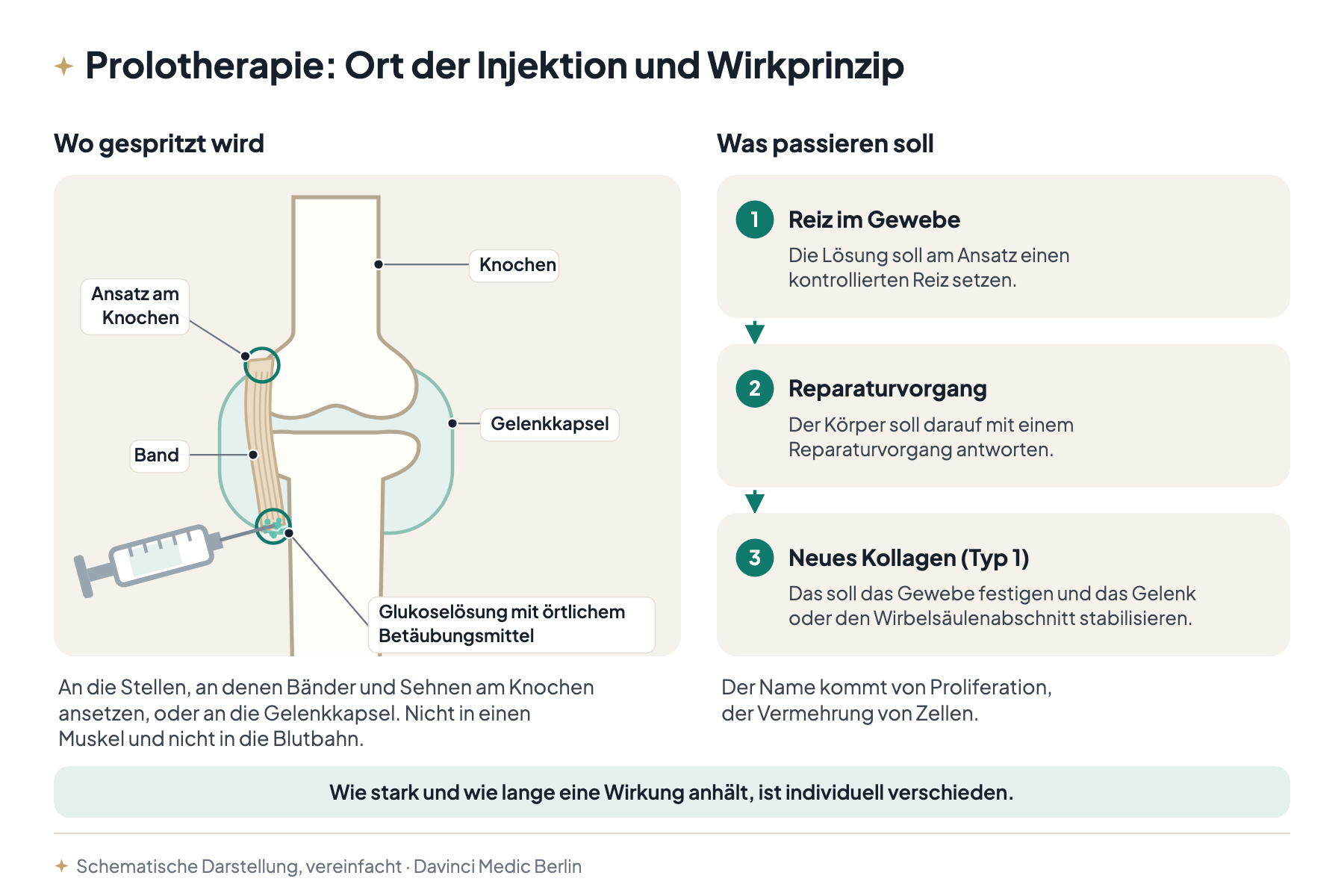
Prolotherapy in Berlin: diagram of a knee with ligament, attachment to the bone and joint capsule, injection of glucose solution with local anaesthetic at the ligament attachment; alongside, stimulation in the tissue, repair process and new collagen
Schematic illustration: injection site and mechanism of action of prolotherapy.

Course of treatment

  1. Examination: We examine you and identify the structures from which the pain originates. Please bring any existing findings, such as X-ray or MRI images.
  2. Information: We discuss the aim, risks, number of treatments and costs with you before you decide.
  3. Injections: After disinfection and local anaesthesia, we administer the injections with very fine needles in a targeted manner at the attachments of ligaments and tendons or into the joint capsule. This means the procedure is usually well tolerated.
  4. Afterwards: You can leave the practice again after a short time. Increased pain at the treated sites is common in the following 24 to 48 hours.
  5. Treatment series: As a rule, this consists of a total of 6 treatments at intervals of 1 week up to a maximum of 6 weeks. During and after the series, we prescribe physiotherapy to stabilise the muscles.
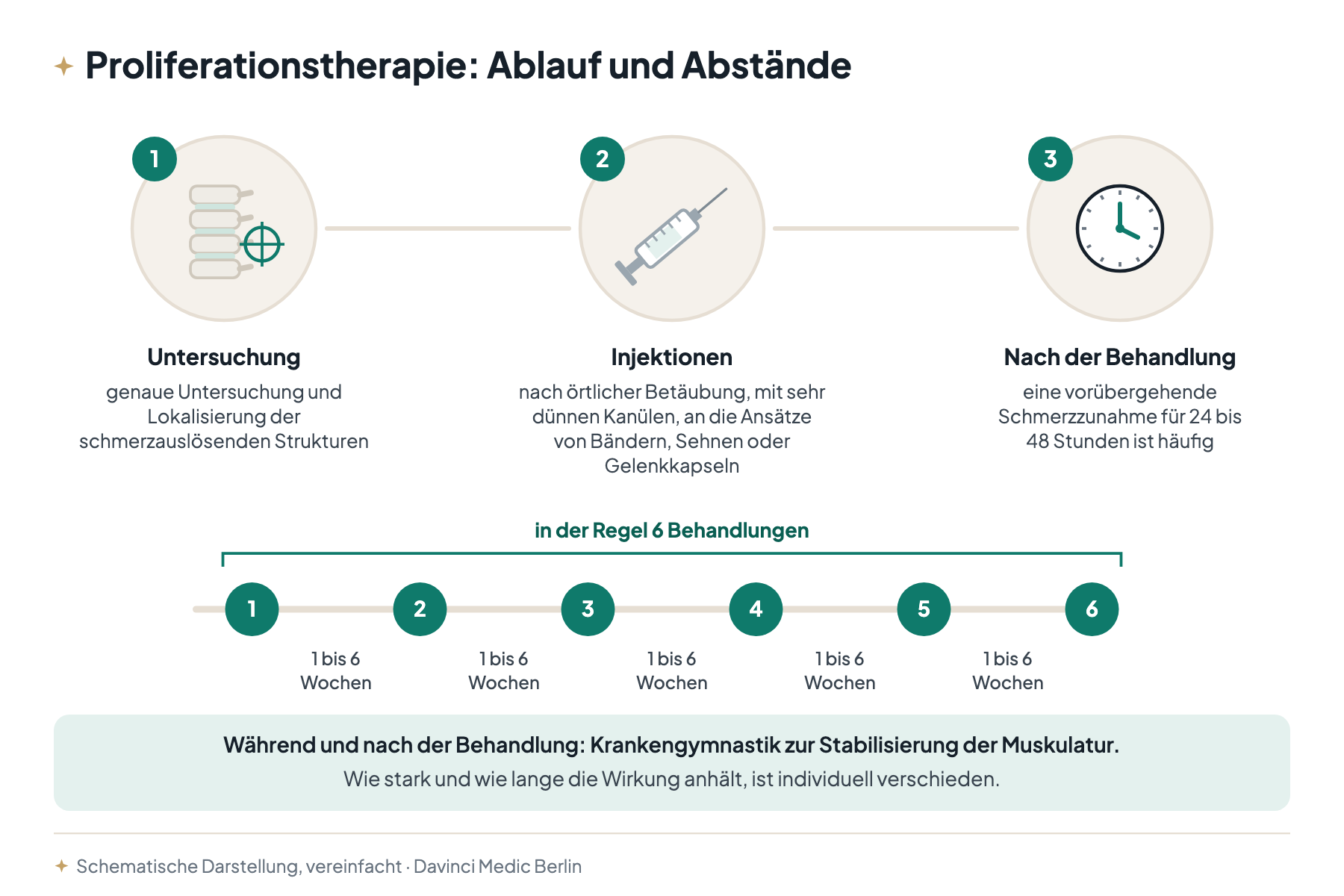
Prolotherapy in Berlin, process: examination, injections into ligaments and tendons, usually 6 treatments at intervals of 1 to 6 weeks
Schematic illustration: course and intervals of prolotherapy.

Side effects and risks

With appropriate injection technique and glucose as the solution, prolotherapy is usually well tolerated. Increased pain, a feeling of tension or slight swelling at the injection sites are common for 24 to 48 hours after each treatment. Occasionally, a small bruise develops.

As with any injection, infections, allergic reactions to the anaesthetic or injuries to nerves and vessels are rarely possible. For injections on the chest, injury to the pleura is a very rare possibility. We discuss these risks with you in detail before the first treatment.

When is prolotherapy not suitable?

We do not treat, or only after consultation, in cases of:

  • acute infections or fever
  • inflammation or injuries of the skin at the injection site
  • known allergy to local anaesthetics
  • blood clotting disorders or use of anticoagulant medication (please do not stop these on your own; we discuss the approach with you)
  • pregnancy

Please bring a list of your medications. Anti-inflammatory painkillers such as ibuprofen or diclofenac can weaken the intended stimulus. We discuss with you whether you should avoid them around the time of treatment and what you can take instead.

What do studies say about prolotherapy?

The evidence from studies is mixed. For knee osteoarthritis, a randomised study reports less pain and better function after glucose injections than after saline injections or home exercises (Rabago and colleagues, 2013). For chronic low back pain, a Cochrane review concludes that prolotherapy alone does not show a clear benefit, but combined with exercises and other measures it can reduce pain and limitations (Dagenais and colleagues, 2007).

We therefore do not use prolotherapy as a sole treatment, but together with physiotherapy, and decide after the examination whether it is suitable for you.

Sources (English): Rabago D. et al., Dextrose prolotherapy for knee osteoarthritis, Ann Fam Med 2013; Dagenais S. et al., Prolotherapy injections for chronic low-back pain, Cochrane Database Syst Rev 2007

What does prolotherapy cost?

Prolotherapy is not a service covered by statutory health insurance. We bill it according to the Schedule of Fees for Doctors (GOÄ). Whether and to what extent a private health insurer or allowance scheme covers the costs depends on your tariff. We will tell you the estimated costs of the treatment series before starting.

Frequently asked questions about prolotherapy

The injection is usually well tolerated thanks to the very fine needles and local anaesthesia. Increased pain at the treated sites is common in the 24 to 48 hours afterwards. It subsides on its own.

A highly concentrated glucose solution (dextrose), mixed with a local anaesthetic. It does not contain cortisone.

Usually 6 treatments at intervals of 1 week up to a maximum of 6 weeks. How many are needed in your case depends on the findings and the course of treatment.

The body remodels the tissue over weeks. A possible improvement therefore usually only becomes apparent during the course of the treatment series, not directly after the first injection. How strong and how long it lasts varies from person to person. It cannot be promised.

Everyday activities are usually possible straight afterwards. You should avoid heavy strain and sport that places stress on the treated site in the first few days. We discuss with you what is sensible in your case.

Statutory health insurers do not cover prolotherapy. Private health insurers and allowance schemes reimburse fully, partially or not at all, depending on the tariff. We bill according to the Schedule of Fees for Doctors (GOÄ) and tell you the costs beforehand.

At the orthopaedic practice of Dr. Homssi (specialist in orthopaedics and trauma surgery) at Greifswalder Straße 137-138 in Berlin-Prenzlauer Berg, accessible by tram M4 and the S-Bahn to Greifswalder Straße. Examination and injections are carried out by a doctor.

Request a consultation appointment

Would you like to know whether prolotherapy is suitable for your condition? Write to us using the contact form or by email at info@davincimedic.de.